.

.
Hand in Hand Around the World

Sunday, February 11, 2018

World Financial Secrecy Index 2018


The Financial Secrecy Index ranks jurisdictions according to their secrecy and the scale of their offshore financial activities.  A politically neutral ranking, it is a tool for understanding global financial secrecy, tax havens or secrecy jurisdictions, and illicit financial flows or capital flight. Some of the criteria used to build the index include the absence of a public register, harmful tax residency rules and whether the system allows for bearer shares, which obscure ownership.

An estimated $21 to $32 trillion of private financial wealth is located, untaxed or lightly taxed, in secrecy jurisdictions around the world. Secrecy jurisdictions - a term we often use as an alternative to the more widely used term tax havens - use secrecy to attract illicit and illegitimate or abusive financial flows.


Switzerland and the United States are the biggest promoters of financial secrecy according to the Tax Justice Network (TJN). Cayman Islands, Hong Kong, Singapore, Luxembourg, Germany, Taiwan, the UAE and Guernsey rounded out the list’s top ten. 

The Financial Secrecy Index reveals that traditional stereotypes of tax havens are misconceived. The world’s most important providers of financial secrecy harboring looted assets are mostly not small, palm-fringed islands as many suppose, but some of the world’s biggest and wealthiest countries. Rich OECD member countries and their satellites are the main recipients of or conduits for these illicit flows.

Saturday, February 10, 2018

Global Shift in Wealth


The world has now accumulated $215 trillion in private wealth, a 12% increase over 2017, according to the latest report by market research company New World Wealth. This number today includes wealth held by the general population, as well as the 15.2M millionaires ($1M+ in assets), 584,000 multi-millionaires ($10M+ in assets), and 2,252 billionaires ($1B+ in assets) in the world.


Top Countries Adding Wealth

Over the last decade, from 2007 to 2017, here are the top countries based on percentage of new wealth added (in USD terms):

Rank Country Wealth Growth (2007-2017)
#1 Vietnam 210%
#2 China 198%
#3 Mauritius 195%
#4 Ethiopia 190%
#5 India 160%
#6 Sri Lanka 133%
#7 Panama 125%
#8 Uruguay 117%
#9 Malta 95%
#10 Indonesia 92%

Friday, February 2, 2018

Global Democracy Index 2017


Global democracy has declined significantly over the last year, according to the latest edition of the Democracy Index. The Democracy Index provides a snapshot of the current state of democracy worldwide. The Index is based on five categories: electoral process and pluralism; civil liberties; the functioning of government; political participation; and political culture. Based on their scores on 60 indicators within these categories, each country is then itself classified as one of four types of regime: full democracy; flawed democracy; hybrid regime; and authoritarian regime.


In the 2017 Democracy Index the average global score fell from 5.52 in 2016 to 5.48 (on a scale of 0 to 10). Some 89 countries experienced a decline in their total score compared with 2016, more than three times as many as the countries that recorded an improvement (27), the worst performance since 2010-11 in the aftermath of the global economic and financial crisis. The other 51 countries stagnated, as their scores remained unchanged compared with 2016. 

Norway once again tops the Democracy Index global ranking in 2017. The Nordics occupy the top three spots, with Iceland and Sweden taking second and third place. New Zealand comes in fourth place and Denmark in fifth. Finland is not far behind, in ninth place with a total score above 9. At the other end of the rankings North Korea, with a total score of 1.08, remains firmly ensconced in last place. Syria, Chad, the Central African Republic (CAR) and the Democratic Republic of Congo (DRC) also bring up the rear, occupying the four slotsabove North Korea. The scores for Syria and Chad did not change in 2017 compared with 2016, but the scores for CAR and the DRC both declined in 2017.
  

Wednesday, January 31, 2018

World's Most Exciting Cities 2018


What’s the greatest city in the world? It’s a hotly contested title – but after asking 15,000 people all over the world, Time Out England Limited came up with a pretty convincing answer. They quizzed thousands of urbanites for this year’s Time Out City Life Index, and scored 32 cities on criteria such as food, drink, culture, friendliness, affordability, happiness and liveability. Here’s the final ranking: the most exciting cities in the world to live in and visit in 2018.

Time Out City Life Index 2018

Monday, January 15, 2018

World’s Most Business-friendly Countries


Doing Business measures aspects of business regulation and their implications for firm establishment and operations. It does not include all the issues that are relevant for businesses’ decisions, but it does cover important areas that are under the control of policy makers. Governments worldwide recognize the economic and political benefits of improved business regulation. (Maps of the World)


 New Zealand is the number one country in terms of ease of doing business. The country, which has retained the number one spot, has a favorable business climate and a regulatory environment that is good to start or run an organization. New Zealand is also placed at the top in starting a business, getting credit, and registering property.
 
Singapore was placed second in the World Bank’s 2018 Doing Business Report. Singapore is a great destination to do business and has a conducive business environment. The European nation of Denmark is placed at the third spot. The nation, which has a favorable business environment, has seen massive investments being made by foreign companies in recent years. One of these is Bristol-Myers Squibb, which is a leading American pharmaceutical firm. The other countries and regions among the top 10 in the World Bank’s 2018 Doing Business Report were South Korea, Hong Kong (China), United States, United Kingdom, Norway, Georgia, and Sweden.

China, which is the second largest economy by nominal GDP, was placed at the 78th spot among the nations in terms of ease of doing business. In contrast, Taiwan (China), occupied the 15th spot. India, which is an emerging superpower, occupied the 100th spot. Last year, it was placed at the 130th spot. Australia, Canada, Germany, and France occupied the 14th, 18th, 20th and 31st position respectively.

Placed at the bottom ten are Somalia, Eritrea, Venezuela, South Sudan, Yemen, Libya, Central African Republic, Afghanistan, Democratic Republic of Congo, and Haiti.
Source: World Bank Doing Business Report

Saturday, January 13, 2018

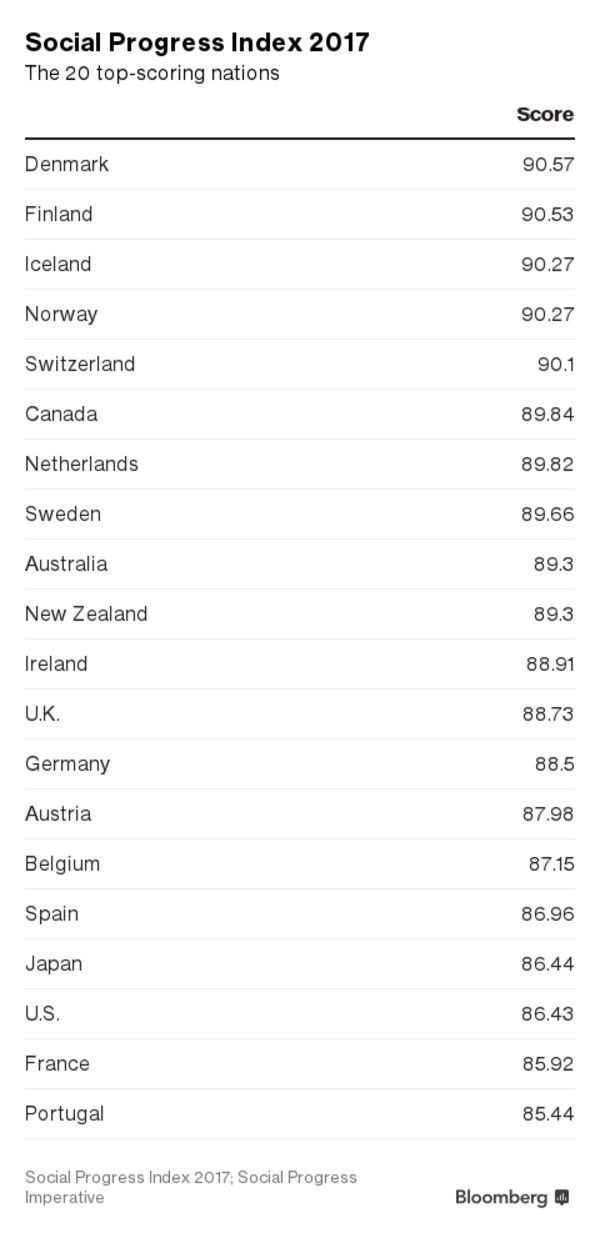
Social Progress Index 2017


The Social Progress Index (SPI) defines social progress as the capacity of a society to meet the basic human needs of its citizens, establish the building blocks that allow citizens and communities to enhance and sustain the quality of their lives, and create the conditions for all individuals to reach their full potential. Improving quality of life is a complex and multilayered endeavor, and past efforts to measure progress simply haven’t created a sufficiently nuanced picture of what a healthy society looks like. The SPI score is an average across scores for the three broad dimensions: Basic Human Needs, Foundations of Well being, and Opportunity.


While much of northern Europe continues to provide affordable healthcare, promote equality, and minimize poverty rates, across the Atlantic the US is getting more divided and less tolerant. Compared to other countries with similar GDP, the US is lagging in its homicide rates, terrorism, and its traffic deaths. (Business Insider)

Hungary and Nicaragua are among nine countries that have shown the biggest declines in overall social progress, the study found, and are doing worse since the index was first done in 2014. The SPI team notes that achieving positive change is harder for the wealthier, top-ranked countries. Small improvements in low- or middle-income countries can produce large gains in the SPI ranking. Many of the world’s wealthiest countries, including the U.S., China, France and Russia, are barely improving in the index.