.

.
Hand in Hand Around the World

Wednesday, January 31, 2018

World's Most Exciting Cities 2018


What’s the greatest city in the world? It’s a hotly contested title – but after asking 15,000 people all over the world, Time Out England Limited came up with a pretty convincing answer. They quizzed thousands of urbanites for this year’s Time Out City Life Index, and scored 32 cities on criteria such as food, drink, culture, friendliness, affordability, happiness and liveability. Here’s the final ranking: the most exciting cities in the world to live in and visit in 2018.

Time Out City Life Index 2018

Monday, January 15, 2018

World’s Most Business-friendly Countries


Doing Business measures aspects of business regulation and their implications for firm establishment and operations. It does not include all the issues that are relevant for businesses’ decisions, but it does cover important areas that are under the control of policy makers. Governments worldwide recognize the economic and political benefits of improved business regulation. (Maps of the World)


 New Zealand is the number one country in terms of ease of doing business. The country, which has retained the number one spot, has a favorable business climate and a regulatory environment that is good to start or run an organization. New Zealand is also placed at the top in starting a business, getting credit, and registering property.
 
Singapore was placed second in the World Bank’s 2018 Doing Business Report. Singapore is a great destination to do business and has a conducive business environment. The European nation of Denmark is placed at the third spot. The nation, which has a favorable business environment, has seen massive investments being made by foreign companies in recent years. One of these is Bristol-Myers Squibb, which is a leading American pharmaceutical firm. The other countries and regions among the top 10 in the World Bank’s 2018 Doing Business Report were South Korea, Hong Kong (China), United States, United Kingdom, Norway, Georgia, and Sweden.

China, which is the second largest economy by nominal GDP, was placed at the 78th spot among the nations in terms of ease of doing business. In contrast, Taiwan (China), occupied the 15th spot. India, which is an emerging superpower, occupied the 100th spot. Last year, it was placed at the 130th spot. Australia, Canada, Germany, and France occupied the 14th, 18th, 20th and 31st position respectively.

Placed at the bottom ten are Somalia, Eritrea, Venezuela, South Sudan, Yemen, Libya, Central African Republic, Afghanistan, Democratic Republic of Congo, and Haiti.
Source: World Bank Doing Business Report

Saturday, January 13, 2018

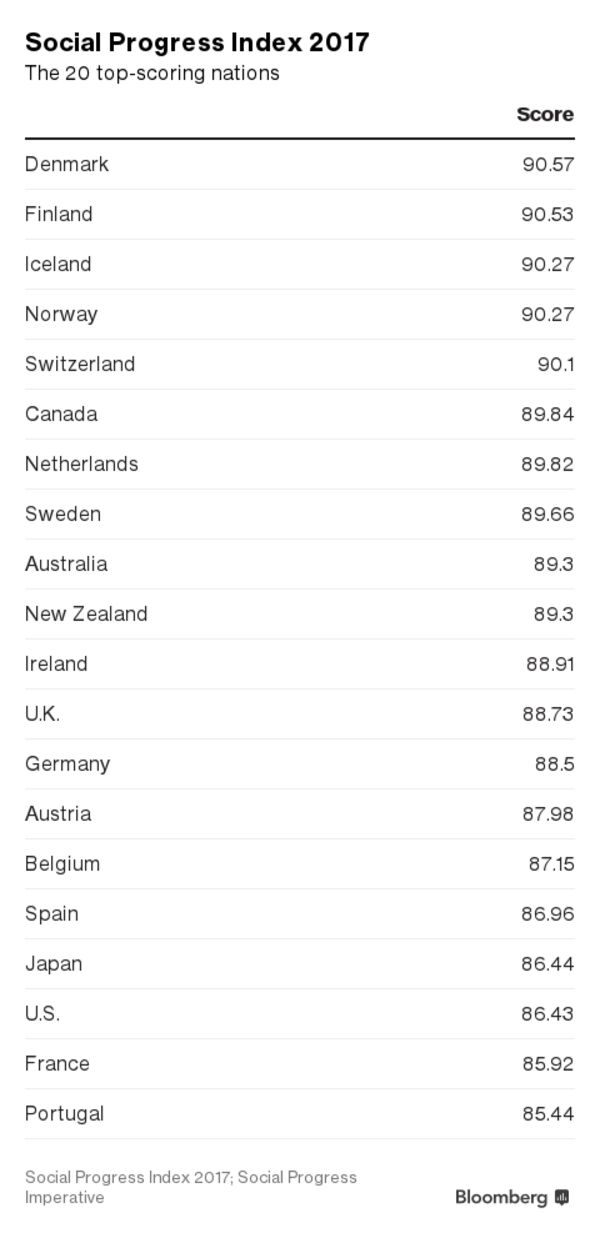
Social Progress Index 2017


The Social Progress Index (SPI) defines social progress as the capacity of a society to meet the basic human needs of its citizens, establish the building blocks that allow citizens and communities to enhance and sustain the quality of their lives, and create the conditions for all individuals to reach their full potential. Improving quality of life is a complex and multilayered endeavor, and past efforts to measure progress simply haven’t created a sufficiently nuanced picture of what a healthy society looks like. The SPI score is an average across scores for the three broad dimensions: Basic Human Needs, Foundations of Well being, and Opportunity.


While much of northern Europe continues to provide affordable healthcare, promote equality, and minimize poverty rates, across the Atlantic the US is getting more divided and less tolerant. Compared to other countries with similar GDP, the US is lagging in its homicide rates, terrorism, and its traffic deaths. (Business Insider)

Hungary and Nicaragua are among nine countries that have shown the biggest declines in overall social progress, the study found, and are doing worse since the index was first done in 2014. The SPI team notes that achieving positive change is harder for the wealthier, top-ranked countries. Small improvements in low- or middle-income countries can produce large gains in the SPI ranking. Many of the world’s wealthiest countries, including the U.S., China, France and Russia, are barely improving in the index. 

Thursday, December 14, 2017

The World's Deserts


A desert is a barren area of land where little precipitation occurs and consequently living conditions are hostile for plant and animal life. About one third of the land surface of the world is arid or semi-arid. This includes much of the polar regions where little precipitation occurs and which are sometimes called polar deserts or "cold deserts". The deserts found on Earth are extremely diverse, each unique in their own way. The dunes of the Saharan Desert, the icy tundra of Antarctica, and the Pacific coastline of the Atacama Desert are all deserts. 
There are four different types of deserts based upon their geographic situation:
1.  Polar deserts (Ex: Arctic & Antarctic)

2. Subtropical deserts (Ex: Sahara, Kalahari, Arabian, Great Victoria etc.)

3. Cold winter deserts (Ex: Great Basin, Gobi etc.)

4. Cool coastal deserts (Ex: Namib, Atacama)


The largest deserts in the world are polar deserts. The Antarctic Polar Desert is the largest and covers the continent of Antarctica and has a size of about 5.5 million square miles. The second-largest desert is the Arctic Polar Desert. It has a surface area of about 5.4 million square miles. 

Sahara is the third largest desert overall, and the largest “hot desert” in the world. This desert comprises most of the land in North Africa. The Arabian Desert is situated on the Arabian peninsula, and makes up parts of Iraq, Jordan, Kuwait, Oman, Qatar, Saudi Arabia, the United Arab Emirates, and Yemen. Both the Sahara and Arabian Deserts are known for their sand and sand dunes. The center of Arabian Desert, Rub ’al-Khali, the “Empty Quarter”, forms the largest continuous body of sand in the world.

The Gobi is termed as a “rain shadow desert”, as it is in the lee-ward side of the Himalaya ranges which block the rain (“rain shadow”), keeping clouds from the Indian Ocean from reaching Gobi. Most of the Gobi’s surface is not sandy, but rather exposed, bare rock. It is a cold desert and snow occasionally will accumulate on its dunes. Kalahari is a vast, semi-arid savanna in southern Africa.  It happens to get significantly more rainfall and support more diverse life than its counterparts.


 List of Deserts their types and Location (Country, Continent)

Name
Type of Desert
Location
Antarctic
Polar
Antarctica
Arctic
Polar
Alaska, Canada, Greenland, Iceland, Norway,
Sweden, Finland, Russia
Sahara
Subtropical
Northern Africa
Arabian
Subtropical
Arabian Peninsula
Gobi
Cold Winter
China and Mongolia
Patagonian
Cold Winter
Argentina
Great Victoria
Subtropical
Australia
Kalahari
Subtropical
South Africa, Botswana, Namibia
Great Basin
Cold Winter
United States
Syrian
Subtropical
Syria, Iraq, Jordan, Saudi Arabia
Chihuahuan
Subtropical
Mexico
Great Sandy
Subtropical
Australia
Kara-Kum
Cold Winter
Uzbekistan, Turkmenistan
Colorado Plateau
Cold Winter
United States
Gibson
Subtropical
Australia
Sonoran
Subtropical
United States, Mexico
Kyzyl-Kum
Cold Winter
Uzbekistan, Turkmenistan, Kazakhstan
Taklamakan
Cold Winter
China
Iranian
Cold Winter
Iran
Thar
Subtropical
India, Pakistan
Simpson
Subtropical
Australia
Mojave
Subtropical
United States
Atacama
Cool Coastal
Chile
Namib
Cool Coastal
Angola, Namibia, South Africa
Source: G K Planet

Wednesday, December 13, 2017

Global Food Wastage


Roughly one third of the food produced in the world for human consumption every year — approximately 1.3 billion tonnes — gets lost or wasted. Food losses and waste amounts to roughly US$ 680 billion in industrialized countries and US$ 310 billion in developing countries.That’s important for at least two reasons. The less the world wastes, the easier it will be to meet the food needs of the global population in coming years. Second, cutting back on waste could go a long way to reducing greenhouse gas emissions.

Food waste is a glaring measure of inequality. In poor countries, most of the food waste is on the farm or on its way to market. In South Asia, for instance, half of all the cauliflower that’s grown is lost because there’s not enough refrigeration, according to the United Nations Food and Agriculture Organization. Tomatoes get squished if they are packed into big sacks. In Southeast Asia, lettuce spoils on the way from farms to city supermarkets. Very little food in poor countries is thrown out by consumers. It’s too precious.

But in wealthy countries, especially in the United States and Canada, around 40% of wasted food is thrown out by consumers.  The United States as a whole wastes more than $160 billion in food a year. Food waste and loss has a huge carbon footprint: 3.3 billion tons of carbon equivalent. And that’s not all, according to a 2014 report from the F.A.O. Wasting that much means a lot of water is wasted, too — the equivalent of three times the size of Lake Geneva, as the report puts it.

Some of the most basic fixes are at the bottom end of the supply chain: Metal grain silos have helped against fungus ruining grain stocks in countries in Africa. In India, the F.A.O. is encouraging farmers to collect tomatoes in plastic crates instead of big sacks; they squish and rot less. Higher up the food chain, supermarkets are trying to make a dent by changing the way best-before labels are used — making them specific to various food categories to discourage consumers from throwing out food that is safe to eat — or trying to sell misshapen fruits and vegetables rather than discarding them. 


Some countries are trying to regulate food waste. France requires retailers to donate food that is at risk of being thrown out but is still safe to eat. European Union lawmakers are pushing for binding targets to curb food waste by 50% by 2030. Cutting waste would have “at least the same impact or more than changing diets.” Source: The New York Times
  

Tuesday, December 12, 2017

The Global Village


If we could shrink the Earth's population of 7+ billion to a village of precisely 100 people, with all existing human ratios remaining the same, it would look like this:

Half of the villagers would be female, the other half would be male. 26 would be under 14 years old. 8 are 65 years and over. The village would consist of 61 people from Asia, of whom 19 would be from China, and almost 18 would be Indians, there are 15 people from Africa, 10 guys from Europe, not quite 9 would be from South America and the Caribbean, and 5 from North America. 25 would live in substandard housing or have no home at all. 40 would lack access to basic sanitation and 13 would lack access to safe drinking water. 10 would have no job. Villagers with a job would work in agriculture: 36, industry: 21, and services: 43. 10 would live in least developed countries. 3 would be migrants, internally displaced persons, and refugees.


7 would be unable to read and write (age 15 and over). 7 would have a college education. Their native language would be: 12 are speaking Mandarin Chinese, 5 would speak Spanish, 5 would speak English, 5 would speak Hindi or Bengali, 3 would speak Arabic, more than 2 speak Portuguese, 2 speak Russian, 2 speak Japanese, and 1 speaks German, the rest of the villagers can choose one or the other of the 6000 languages spoken on the planet.


82 would be from less developed countries with an average income of US$ 5,440 in a year, this is the equivalent disposable income of just $15 a day, but 51 of those would live on less than $2 a day. 18 would be from developed countries with an average income of US$ 32,470 in a year, the equivalent disposable income of $90 a day. 22 would be overweight.
The richest 1 in our village actually owns 40% of the entire wealth.


51 of our village people live in areas termed “urban”. The number of people living in urban areas has surpassed the population of rural areas approximately in the year 2005. 60 would live within 100 km (62 miles) of a coastline. About 50 would rely in some manner on coastal and marine habitats for food, building sites, transportation, recreation, and waste disposal.

Half of the villagers would distrust their government.  The village's population would use 77 mobile phones, but they are unequally distributed, some of the villagers would have 2 or more cell phones, other none. 33 would be Internet users, 15 would have Internet access from home and 12 would be active users of Facebook. At least 5 would be part of the gay community  Source: Nations Online